


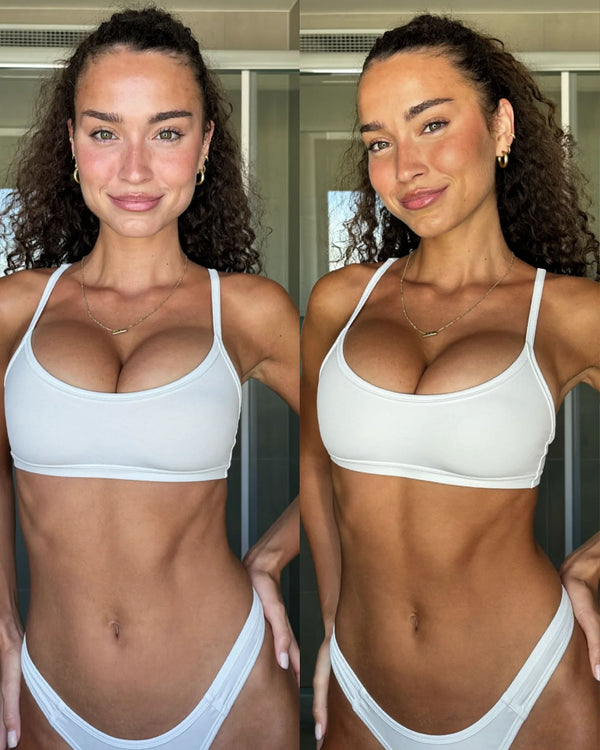





How Often Should You Self Tan? A Complete Guide

Short answer: How often you should self tan depends on the look you want. For a natural glow, reapply every 5 to 7 days. To stay dark year-round, touch up every 4 to 5 days. Before a vacation or event, start 3 to 4 days ahead with 2 to 3 lighter coats. Beginners should tan less often, not more, to learn how their skin actually develops and fades.
How Often Should You Self Tan? A Real-World Guide From Nearly 20 Years in the Tanning Industry
If you've ever wondered how often you should self tan, the honest answer is simple:
It depends on the look you're after.
That's probably not the answer you expected, but after nearly 20 years in the tanning industry, we've learned there isn't one perfect schedule that works for everyone.
Some people want a subtle, healthy glow year-round. Others love maintaining a deep bronze. Some only tan before vacations or special events. Each goal requires a different approach, and trying to follow a one-size-fits-all schedule usually leads to streaks, patchiness, or disappointment.
At MAKAI, we've spent years helping people find a routine that fits their lifestyle, not forcing everyone into the same one.
Table of Contents
- Why You Can Trust Our Advice
- How Often Should You Self Tan for a Natural Glow?
- How Often Should You Self Tan to Stay Dark Year-Round?
- How Often Should You Self Tan Before a Vacation or Event?
- Should Beginners Self Tan More Often?
- The Biggest Mistake People Make
- Advice We Disagree With
- What We've Learned From Real Customers
- One Customer Completely Changed How We Think About Self Tanning
- Why We Formulated MAKAI Differently
- Reapplication FAQs
- Our Philosophy on Self Tanning
Why You Can Trust Our Advice
This isn't advice pulled from a handful of beauty blogs.
Toni has spent nearly two decades in the tanning industry and is an NSTPA-certified spray tan artist. Skin health has always been deeply personal to her after her mother was diagnosed with melanoma when Toni was young. That experience shaped her passion for sun safety, healthy skin, and helping people feel confident without unnecessary UV exposure. We've shared more of that story, and why safety comes first for us, in Is Self Tanner Safe?
Outside of tanning, Toni is also a licensed physical therapist in more than 40 states and continues her education in women's physical health. That broader understanding of the body influences the way we think about skincare and self-care, not just tanning.
During our podcast years, Patt and Toni interviewed leading dermatologists and estheticians from Utah and Dallas, discussing everything from skin health to ingredient science and proper skincare routines.
On the product side, we've tested dozens upon dozens of self-tanning formulas across different skin tones, body types, climates, and lifestyles. We've watched products perform in dry desert air, humid summers, mountain climates, winter weather, rainy conditions, before workouts, after workouts, before long car rides, while wearing white clothing, and under just about every real-life situation you can imagine.
That real-world experience shapes everything we recommend.
How Often Should You Self Tan for a Natural Glow?
If your goal is simply to look like you've spent a relaxing weekend outside, less is usually more.
For most people, applying self tanner every 5 to 7 days works beautifully.
This schedule gives you a healthy, sun-kissed appearance without creating heavy buildup around your elbows, knees, ankles, or hands. A light or medium mousse applied once a week is usually all you need to maintain natural-looking color.
One mistake we see is people trying to stay perfectly tan every single day. In reality, allowing your skin to naturally fade before your next application almost always produces a cleaner, more even result.
How Often Should You Self Tan to Stay Dark Year-Round?
If you enjoy a darker tan throughout the year, you'll typically want to reapply every 4 to 5 days.
Experienced tanners usually don't perform a complete full-body application every single time. Instead, they maintain their color with strategic touch-ups while following a consistent skincare routine.
The people who consistently have the best-looking tans almost always:
- Exfoliate once or twice each week.
- Moisturize daily.
- Allow their tan to fade naturally instead of constantly layering new product.
A good maintenance routine always beats chasing maximum darkness. Our How to Self Tan: The Ultimate Guide walks through the full prep-and-apply process if you want the complete step-by-step.
How Often Should You Self Tan Before a Vacation or Event?
This is probably the biggest misconception we see.
Many people wait until the night before their vacation, wedding, or event and apply one very dark coat, hoping for dramatic results by morning.
In our experience, that's rarely the best approach.
Instead, if you're using a new self tanner, we recommend applying 2 to 3 lighter coats spaced about a day apart, beginning 3 to 4 days before your event.
Think of it like this:
- The first application creates your foundation.
- The second builds depth.
- The third fine-tunes the richness if needed.
It also gives you a buffer day if your color develops darker than expected.
That said, if you've already found a self tanner you trust and know exactly how it develops on your skin, don't overcomplicate it. Stick with your normal routine. For many experienced users, applying the night before works perfectly because they already understand how their skin responds.
Should Beginners Self Tan More Often?
Actually, beginners should usually tan less, not more.
One application followed by a full 5 to 7-day wear cycle teaches you far more than applying multiple coats too quickly.
You'll learn:
- How your skin develops color.
- Where your tan fades first.
- How long your results typically last.
- Whether you actually need a darker shade.
Experienced users already know these answers, so they can comfortably adjust their schedule without creating uneven results. If you're still deciding which format fits your routine best, our Mousse vs. Lotion vs. Cream breakdown can help.
The Biggest Mistake People Make
The biggest mistake isn't buying the wrong self tanner.
It's reapplying too soon.
Self tanner continues developing for roughly 6 to 8 hours after application.
People often apply their tan, check the mirror two hours later, think it isn't dark enough, and immediately add another layer.
That's usually what creates uneven fading, patchiness, and orange-looking buildup later, not the product itself.
Patience almost always produces a better-looking tan.
Advice We Disagree With
One piece of advice we see all the time is:
"Apply self tanner every day for maximum color."
We don't agree.
Daily applications without proper exfoliation simply layer new color over skin that's already fading unevenly.
Eventually your tan starts looking dull, streaky, and heavy.
A better routine is:
- Apply intentionally.
- Moisturize consistently.
- Exfoliate when appropriate.
- Reapply only when your skin actually needs it.
Fewer well-timed applications almost always outperform daily applications.
What We've Learned From Real Customers
One interesting thing we've noticed is that most people naturally get about a week from a quality self tan. If you're curious exactly how long yours should hold up, we cover that in more detail in Does Self Tanner Expire?
Coming from the spray tanning industry, Thursday nights have almost become an unwritten tradition because everyone wants to look their best for the weekend.
We've also noticed that the customers whose tans last the longest almost always share the same habits.
They prepare their skin properly before the first application.
They moisturize consistently.
They let the tan fade naturally.
Many MAKAI customers find that after their initial exfoliation and first application, they can simply apply another coat the following week because the fade is so even. They don't necessarily need to completely restart the process every single time.
Good fading creates easier maintenance.
One Customer Completely Changed How We Think About Self Tanning
One customer spent several hundred dollars every month getting weekly spray tans.
She didn't even enjoy the appointments.
She lived in a small town with only one spray tan artist, didn't particularly like the experience, and still kept going because she believed spray tanning was the only way to achieve the color she wanted.
Eventually she tried MAKAI.
What surprised her wasn't just the color.
- She saved time by eliminating the drive to appointments.
- She saved money every month.
- She no longer had to schedule her life around someone else's availability.
- She actually preferred the results because she could tan whenever it fit her schedule.
That experience reminded us that convenience is part of confidence too. Her story is just one of many, you can read more real customer experiences in Self Tanner Reviews: What 550 Real Customers Say.
Why We Formulated MAKAI Differently
Sometimes people tell us another self tanner looks darker immediately after application.
They're often right.
But that's not the whole story.
Many products rely heavily on cosmetic bronzers or extremely aggressive DHA levels so you feel darker immediately.
The downside is often:
- More stickiness.
- More transfer.
- A stronger self-tanner smell.
- A messier application.
- Less natural fading.
At MAKAI, we intentionally chose a different approach.
Could we make you look dramatically darker in the first hour? Absolutely.
But we'd rather give you a tan that fully develops beautifully, wears comfortably, fades naturally, and leaves you feeling confident from day one through day seven.
Our goal has never been to chase the darkest immediate result.
Our goal is to create the best overall tanning experience.
Reapplication FAQs
How often should I self tan for a natural, everyday glow?
Every 5 to 7 days works best for most people, giving your skin time to fade evenly before the next application.
How often should I reapply to stay dark year-round?
Every 4 to 5 days, using strategic touch-ups rather than a full reapplication each time.
How soon before a vacation or event should I start tanning?
Start 3 to 4 days ahead with 2 to 3 lighter coats spaced about a day apart, rather than one dark coat the night before.
Should beginners self tan more often to get better at it?
No, less often. One application followed by a full 5 to 7 day wear cycle teaches you more about how your own skin develops and fades than applying multiple coats quickly.
How long does self tanner actually take to fully develop?
Roughly 6 to 8 hours. Reapplying before that window closes is one of the biggest causes of uneven, patchy color.
Is it okay to apply self tanner every day?
Not recommended. Daily applications without proper exfoliation layer new color over unevenly fading skin, which leads to a dull, streaky result over time.
Our Philosophy on Self Tanning
We believe people sometimes focus so much on becoming darker that they forget why they're tanning in the first place.
Did your self tanner really work if you're constantly worried about orange hands?
Did it work if your knees and knuckles look unnatural?
Did it work if your tan starts looking like peeling sunburn after only a few days?
Did it work if you dread sleeping because you're sticky all night?
For us, the answer is no.
A great self tanner isn't the one that makes you the darkest. It's the one that makes you feel the most confident.
Self tanner should never change who you are.
It should simply enhance what's already there.
A little more glow.
A little more confidence.
A little more "I feel good today."
That's what we've always believed.
At MAKAI, we don't see people as numbers or skin tones.
We see people.
You're the art.
We're not the canvas.
We're simply the high-quality paint and the brushes that help you create a beautiful result, every single time.


