


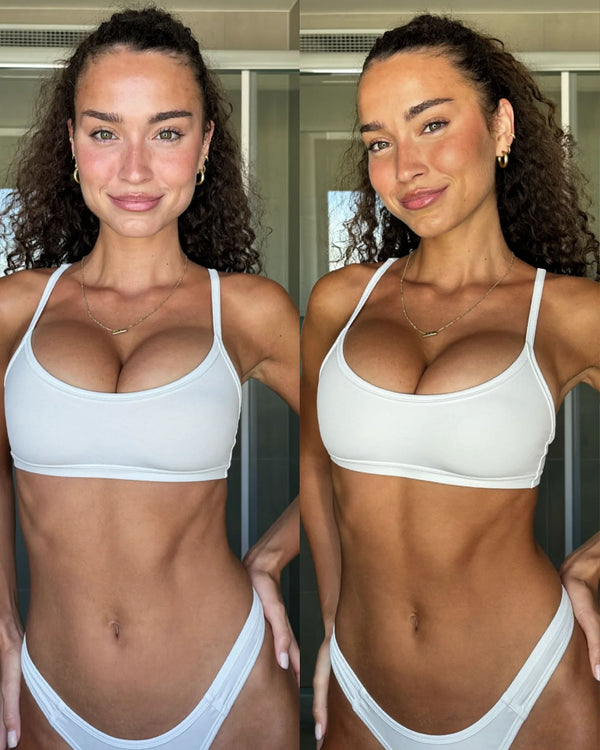




Bronzer vs. Self-Tanner: What's the Difference?

Short answer: Bronzer is a temporary guide color added to help you see where you've applied product, it doesn't determine how dark your tan becomes. DHA is the ingredient that reacts with your skin to create your actual, lasting tan over the next several hours. A darker bronzer doesn't mean a darker tan, so judge a self-tanner by its formula, not by how dark it looks the moment you apply it.
What's the Difference Between Bronzer and Self-Tanner?
If you've ever applied a self-tanner and loved the color immediately, only to rinse it off the next morning and wonder where your tan went, you're not alone. It's one of the biggest misconceptions in the self-tanning industry, and after years of spray tanning clients, developing self-tanning formulas, and helping thousands of customers, I've found that most people don't actually understand the difference between bronzer and self-tanner.
The truth is simple: bronzer is not what tans your skin. Bronzer is temporary. DHA is what creates your long-lasting tan.
Once you understand the difference, you'll know exactly what to look for when shopping for a self-tanner and why some products deliver beautiful, lasting color while others disappoint after the first shower.
Table of Contents
- What Is Bronzer?
- What Actually Creates Your Tan?
- The Biggest Misconception I See
- A Conversation That Perfectly Explains the Difference
- Why I Tell Customers Not to Judge Their Tan Too Early
- Why Formula Matters More Than Bronzer
- Should You Buy a Self-Tanner With a Dark Bronzer?
- My Professional Opinion
- FAQs
- Final Thoughts
What Is Bronzer?
Bronzer, sometimes called a guide color, is the temporary tint added to many self-tanners. Its purpose isn't to create your tan—it's there to help you see where you've applied the product.
Think of it as a roadmap during application.
Bronzer helps you:
- See where you've already applied product.
- Avoid streaks and missed spots.
- Get instant cosmetic color while your tan develops.
What bronzer doesn't do is determine how dark your final tan will become.
What Actually Creates Your Tan?
The real tanning ingredient is dihydroxyacetone (DHA).
DHA reacts with amino acids found in the outermost layer of your skin through a natural chemical reaction. Over the next several hours, that reaction develops into the tan you see after your first rinse. For the full science behind how this works, our Ultimate Guide to Self Tanning breaks down exactly how DHA reacts with your skin.
In other words:
- Bronzer = Instant color
- DHA = Your actual tan
This is one of the biggest misconceptions I hear from customers. Many people assume the dark color they see immediately is the tan itself. In reality, much of that initial color is simply the guide bronzer doing its job.
The Biggest Misconception I See
After years of spray tanning clients and developing self-tanning products, I've noticed the same misunderstanding over and over again.
Many people believe that if a self-tanner has a darker bronzer, it will produce a darker tan.
Unfortunately, that's simply not how self-tanners work.
A product can have an extremely dark guide color while producing only a medium tan after the bronzer rinses away. Likewise, a self-tanner with a lighter guide color can develop into a rich, natural-looking bronze because of its DHA formulation.
That's why judging a self-tanner by the bronzer alone often leads to disappointment.
A Conversation That Perfectly Explains the Difference
I recently spoke with a customer who had eczema and was frustrated because she always searched for self-tanners with the darkest bronzers possible. She believed the darker the bronzer, the darker and longer-lasting her tan would be.
She told me she loved how dark she looked immediately after application, but after showering, she felt like her tan had disappeared.
I explained that what she was seeing immediately after application wasn't actually her tan—it was mostly the guide bronzer.
The lasting color would come from the DHA developing with her skin over the next several hours, not from the temporary cosmetic tint. If you're navigating sensitive or reactive skin like she was, our guide on whether self-tanner is safe for sensitive skin covers patch testing and what to actually look for.
Once she understood the difference, it completely changed how she evaluated self-tanners. Instead of chasing the darkest bronzer, she began looking for better formulas designed to produce a more natural, longer-lasting tan.
Why I Tell Customers Not to Judge Their Tan Too Early
One of the best pieces of advice I can give first-time self-tanner users is this:
Don't judge your tan by the bronzer.
Use the bronzer for exactly what it's designed to do:
- Help you apply the product evenly.
- Show you where you've missed a spot.
- Guide your application.
Then let the DHA do its job.
The color you see immediately after application isn't what you'll wake up with the next morning, and it isn't what you'll see after your first rinse.
Understanding this removes a lot of unnecessary anxiety. Customers stop worrying when the guide color washes away because they know their real tan is still developing.
Why Formula Matters More Than Bronzer
Having developed self-tanning formulas myself, I can confidently say I'd choose a better formula over a darker bronzer every single time.
People often assume that more is better, but that's not necessarily true.
The balance of the DHA is incredibly important.
If there's too much DHA, the product can become tacky and uncomfortable during development. If there's too little, you may not achieve the depth of color you're looking for.
A great self-tanner isn't about packing in the darkest guide color possible. It's about balancing the formula so the tan develops evenly, naturally, and comfortably. If you're deciding between formula types, our breakdown of mousse vs. lotion vs. cream walks through which fits your skin best.
Should You Buy a Self-Tanner With a Dark Bronzer?
Not necessarily.
A darker bronzer may give you more instant gratification, but that doesn't guarantee a darker or longer-lasting tan.
In fact, heavier guide colors can sometimes:
- Feel stickier during development.
- Create more transfer onto clothing or bedding.
- Give unrealistic expectations before the first rinse.
A well-balanced formula, on the other hand, focuses on what actually matters: the tan you'll still have after the bronzer washes away.
My Professional Opinion
If a friend asked me whether they should buy a self-tanner with the darkest bronzer or the best formula, my answer would be simple.
Always choose the better formula.
A dark bronzer might make you feel like you're getting a deeper tan, but once it rinses away, many people end up feeling like they wasted their money because they expected that color to stay.
I'd much rather have a self-tanner that develops into a beautiful, natural-looking bronze than one that relies on an overly dark guide color to impress you for a few hours.
The best self-tanners aren't the ones with the darkest bronzers.
They're the ones with formulas that develop evenly, feel comfortable during wear, fade naturally, and deliver a tan you're still happy with days later. Browse the full self tanner collection to compare formulas for yourself.
FAQs
Does a darker bronzer mean I'll end up with a darker tan?
No. Bronzer is a temporary guide color, not the ingredient that creates your actual tan. A product can have a very dark bronzer and still develop into only a medium tan once it's rinsed off.
Why did my tan look so much darker right after I applied it than it did the next morning?
What you're seeing right after application is mostly the guide bronzer, not your real tan. The actual color comes from DHA reacting with your skin over the following hours, which is why the color shifts once you rinse and wake up.
Is it a problem if a self-tanner doesn't have a bronzer at all?
Not at all. Some formulas skip the guide color entirely and still produce excellent, even results. Bronzer is a helpful application tool, not a requirement for a good tan.
Can I tell how dark my tan will end up just by looking at the bottle's color?
No. The bottle or initial application color reflects the bronzer, not the finished result. The only reliable way to know how a formula develops is to try it and judge the color after it's fully developed and rinsed.
Final Thoughts
If there's one thing I hope you take away from this article, it's this:
Bronzer is temporary. DHA creates the tan.
Once you understand that difference, shopping for self-tanner becomes much easier. Instead of chasing the darkest guide color, you'll know to look for a thoughtfully formulated product that develops naturally with your skin.
After years of spray tanning clients, formulating self-tanning products, and educating customers, I've found that this simple distinction changes the way people approach self-tanning—and almost always leads to better results.


