






Self-Tanning Results You Can Actually Expect

Short answer: The color you see right after applying self-tanner is mostly cosmetic bronzer, not your final result. Give the product its full development time (6-8 hours for mousse), rinse off the bronzer, then judge your tan the next day. A properly developed self-tan from MAKAI typically lasts 7+ days.
Self-tanning can seem intimidating if you've never done it before. At MAKAI pop-ups, we regularly meet people who have never self-tanned because they assume it will be messy, uneven, sticky, or difficult to get right. Others have had a bad experience in the past and assume every self-tanner will give them the same result.
But here's what we've learned from talking to customers, testing our products, and seeing real tans develop in everyday life: a good self-tan doesn't have to be complicated.
Once you understand what you're actually seeing during the development process, what the bronzer is doing, how long your tan needs to develop, and which type of self-tanner fits your goals, the process becomes much more predictable.
Here's what you can realistically expect from a self-tan, from the moment you apply it through the first week.
What Does a Self-Tan Actually Look Like When It Develops?
One of the biggest misconceptions we hear from customers is that the color they see immediately after applying self-tanner is the final result.
It isn't.
Most self-tanners contain a cosmetic bronzer that gives you immediate color while the tanning ingredients develop underneath. The bronzer is there for an important reason: it helps you see where you've applied the product so you can create an even tan. For a deeper look at what each ingredient is actually doing, see bronzer vs. self-tanner: what's the difference.
That means you may look significantly darker immediately after application than you will after your first shower. That's completely normal.
Immediately After Applying Self-Tanner
Right after application, you're mostly seeing the cosmetic bronzer along with the beginning stages of your actual tan.
This is why you may look darker than expected. It can be tempting to think, "Wow, this is really dark," but don't judge your final color yet.
The bronzer is essentially your application guide. If you can see where the product is going, you can make sure you're covering everything evenly.
After 6-8 Hours
This is where patience matters.
For our mousse, we recommend allowing the tan to develop for approximately 6-8 hours. By this point, the color has had the time it needs to fully develop.
One thing we've specifically tested is whether leaving the mousse on for 10-12 hours will make the tan significantly darker than leaving it on for the recommended development time. It doesn't work that way.
Once the tan has fully developed, keeping it on substantially longer isn't simply going to keep adding more and more color.
In other words, longer isn't automatically darker.
After You Rinse
This is probably the moment that causes the most unnecessary panic for first-time self-tanners.
You get in the shower, see a lot of brown color washing down the drain, and think, "Did I just wash my tan off?"
No.
What you're seeing wash away is primarily the cosmetic bronzer that helped you see where you applied the product. The actual developed tan remains.
This is important because there's almost a placebo effect that can happen when you're new to self-tanning. You see a darker color when you apply the product, then you see that color disappear in the shower, so it can feel like the tan disappeared too.
It didn't.
After you rinse, your color should look much more natural, especially if you allowed the tan to develop for the full recommended time.
↑ Back to topWhat Should Your Self-Tan Look Like the Next Day?
The next day is a much better time to judge your result than immediately after application or immediately after your first shower.
By then, you're seeing the developed color rather than relying on the cosmetic bronzer to tell you what your tan looks like.
This is also when you can really appreciate the difference between a tan that simply looks dark and a tan that looks natural.
In our experience, people often assume the darkest possible result is the best result. We don't agree.
A natural-looking tan is usually a much more enjoyable tan.
You shouldn't have to feel sticky or uncomfortable for hours and think, "This must be working because I feel gross." A self-tan can go on smoothly, develop while you're going about your day, and leave you with natural-looking color.
↑ Back to topDoes Fake Tan Look Natural?
Yes, fake tan can look completely natural when the shade fits your skin, you use the right amount of product, and the formula fades evenly. Most fake-looking tans come down to one of those three things going wrong, not self-tanning itself.
When people at our pop-ups tell us they're worried about looking fake, "orange" is rarely the whole story. What they're really picturing is a tan that looks tacky or leathery, skin that looks roasted or burnt, patchy and splotchy hands, or a change so dramatic that it doesn't just look like a fake tan, it looks like a dirty fake tan.
The good news is that every one of those is avoidable.
What Makes Self-Tan Look Fake?
In our experience, a fake-looking result usually comes from one of these:
- Using way too much product, especially on hands, feet, wrists, and ankles
- A cheap tanner that develops and fades unevenly
- Skipping exfoliation, so the tan grabs onto dry patches or leftover color
- Applying over oils or other barriers on the skin that block even development
- Choosing a shade that doesn't fit your natural skin tone
Get those right, and most of the "fake tan" look disappears.
Match the Tan to Your Skin, Not a Rule
You've probably heard "start light and build up." It's good advice, but it doesn't apply to everyone.
It really applies to fair skin with reddish undertones, like Toni's, where going too dark too fast is more likely to look off. If you naturally tan easily, that advice doesn't really apply to you.
For people who tan easily, Dark or Ultra Dark is usually the better starting point. With Dark, you can layer additional coats if one application isn't quite the depth you want. With Ultra Dark, a single coat is often all you need, especially if you already have a base tan going into it.
At our pop-ups, Toni talks people through their skin undertone and what tends to look best on different skin tones, whether that's fair skin looking for a glow or deeper skin that just wants more definition. That conversation almost always eases the worry. To work through it on your own, start with our guide on how to find your self-tan shade.
How to Keep Hands, Feet, and Wrists Looking Natural
Splotchy hands are one of the fastest giveaways, and the two biggest causes we see are using way too much tanner and applying it directly to those areas.
The skin on your hands, feet, wrists, and ankles is thinner than the rest of your body. Instead of putting fresh product there, finish the rest of your body first, then use only the excess left on your mitt to lightly go over those areas. That's usually all the color they need.
Toni really honed this technique during her years as a spray tan artist. Some clients drove hours just to get a tan from her, and for people who didn't live within commuting distance, she sent them self-tanner instead, so getting hands and feet right without her there mattered.
Why an Even Fade Matters Most
A tan can look perfect on day two and still end up looking fake if it fades in patches.
That was the problem Toni wanted to solve when we developed our products. After years of spray tanning, she said the worst thing about any spray tan was the patchy ending. She knew that if we could send people a product that faded evenly, they would love it.
That's why we don't use excessive amounts of DHA in our products, which gives you a more natural fade. Every product is also made to be buildable, so you don't have to worry about a patchy fade when you layer.
Toni's sister is living proof. She layers her tan on without ever really properly exfoliating, and she's so confident in the result that there's no telling her otherwise. We always suggest exfoliating off your old tan before reapplying as best practice, but a buildable formula gives you some room to live your life.
With most other tanners, a patchy fade usually comes back to skipping exfoliation, using a cheap tanner, or applying over oils and barriers on the skin.
Self-Tan Is for Everyone
Natural looks different depending on who you are. Patt, MAKAI's co-founder, explains it this way:
"As a Black man who uses self-tanner, I want people to know it's for everyone. I use our Dark or Ultra Dark when I want to look a little more defined, especially on my arms and chest. A natural tan for me looks like I'm not tan at all. What you see is my actual skin tone. To be honest, if I didn't tell people, they would never know I use tanner for some definition here and there. One reason is that people typically assume Black people and men don't self-tan. The other is that it truly looks like my natural skin tone."
That's the real answer to whether fake tan looks natural: when the shade, the amount, and the formula are right, nobody sees a fake tan. They just see you.
↑ Back to topHow Long Should a Self-Tan Last?
How long a tan lasts depends on the product, your skin, your routine, and how much wear and tear your skin experiences.
With our mousse, customers can typically expect the tan to last 7+ days.
And that's real life, not a perfect laboratory environment.
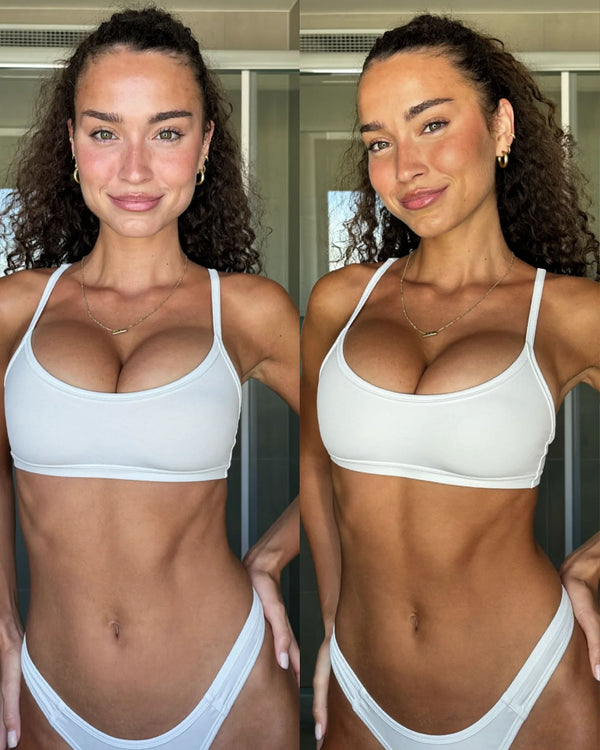
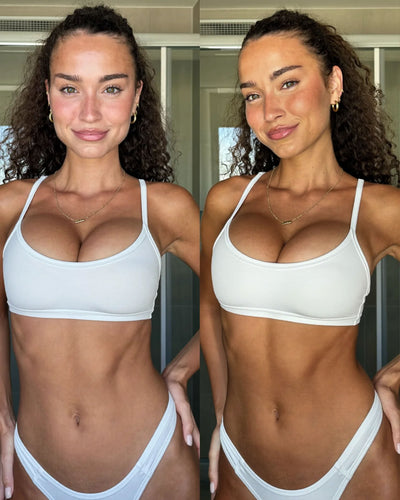
We've looked at what the color actually does over time, including normal activities like sweating and getting in the pool. We have before-and-after images showing the starting point, the result around 24 hours later, and what the tan looks like after approximately a week of normal living. If you're wondering exactly how water and sweat affect that timeline, we break it down further in how long a spray tan lasts and how to maintain it.
That's one reason we think it's important to look beyond the first few hours when evaluating a self-tanner. A product can look great immediately, but how it develops and fades is just as important.

↑ Back to top
Not All Self-Tanners Are the Same
Another misconception we hear at pop-ups is that all self-tanners are basically the same.
We understand why people think that. If the only self-tanner you've seen at a store is a typical quick-developing mousse, it's easy to assume that's simply what self-tanning is.
There are actually different types of products designed for different goals.
Quick-Developing Mousse
A quick-developing mousse is a great option for someone who is already familiar with self-tanning or has used a traditional self-tanning mousse before.
We generally recommend having realistic expectations based on products you've actually used before. A quick mousse can contain more cosmetic bronzer to give you noticeable color while you're wearing it, but because the product is designed to develop more quickly, it may also fade somewhat faster or not wear as smoothly as a slower-developing option.
For someone who already understands the self-tanning process, our ultra dark self-tanning mousse can be an easy, reliable way to build noticeable color.

Gradual Tanning Lotion
Gradual tanning lotion is one of the most flexible options because it can work for just about anyone.
It's especially useful if you want to maintain a subtle-to-moderate level of color rather than going for a deep, dark tan.
It can also be used after a darker mousse to help maintain or build your color as your original tan starts to fade.
Body Self-Tanning Mist
A body self-tanning mist is another option when your goal isn't necessarily to build the deepest possible tan.
Our self-tanning mist gives you a nice coconut scent and even-looking color, making it a great option for a weekend, vacation, night out, or anytime you're showing more skin and want some additional glow.
The tradeoff is that a mist typically won't last as long as a mousse. That's not necessarily a negative. If your goal is a nice-looking glow for a specific occasion, you may not need a product designed to last a full week.
↑ Back to topDoes Your Self-Tanning Routine Need to Be Complicated?
No.
Whether you're a complete beginner or someone who has been self-tanning for years, we believe the basic process is the same:
- Prep your skin
- Apply the product evenly
- Give it the proper development time
That's really it.
Once you learn how to do it, it's like riding a bike. For a full step-by-step walkthrough of the whole process, from prep to development, check out how to self tan: the ultimate guide.
We believe preparation helps the tan go on more smoothly and evenly, and using a clean application mitt is part of that process.
You don't need to make self-tanning into a complicated ritual. Good preparation and consistent application will take you a long way.
↑ Back to topThe Biggest Mistake: Thinking the Darkest Tan Is the Best Tan
If there's one mindset we'd love to change about self-tanning, it's this one.
Darker does not automatically mean better.
We've talked to plenty of people who assume that a good self-tan should be extremely dark, sticky, uncomfortable, or obvious.
It doesn't.
A great self-tan can look natural. It can go on smoothly. It can develop without you feeling like you've covered yourself in something unpleasant. And it can give you enough color that people notice you look good without immediately thinking, "That's a fake tan."
That's the result we think people actually want.
↑ Back to topWhat If You've Never Self-Tanned Before?
If you've never self-tanned before, don't let the idea of an uneven or messy result stop you from trying it.
One of the most common things we hear at our pop-ups is that people are nervous because of a previous experience or because they've seen someone else's bad self-tan.
Our advice is simple: don't assume every self-tanner will behave the same way.
Start with good preparation, use a clean mitt, follow the development instructions, and don't judge the color while the cosmetic bronzer is still doing its job.
And here's something else we'd genuinely recommend: take a picture.
Before you apply the tan, take a photo of yourself.
Seriously. Forget worrying about whether you "look good enough" without a tan. You look good. Take the picture.
Then take another picture the next day.
Seeing the actual before-and-after difference can be much more useful than trying to remember what your skin looked like before you applied the product.

↑ Back to top
How to Know If Your Self-Tan Actually Worked
Don't judge your self-tan based on how dark you look immediately after applying it.
Don't judge it based on how much brown color you see going down the drain.
And don't assume that leaving it on for 12 hours will automatically make it better than leaving it on for the recommended development time.
Instead, look at the color after the product has had the appropriate time to develop and you've rinsed away the cosmetic bronzer.
Then look at how the color wears over the following days.
That's your real result.
↑ Back to topThe Bottom Line on Self-Tanning Results
The biggest difference between a disappointing self-tan and a great one often comes down to expectations.
Self-tanner isn't supposed to instantly give you your final color. The bronzer you see immediately after application isn't necessarily the color you'll have the next day. The color washing off in the shower doesn't mean your tan washed away. And leaving a product on longer than its recommended development time doesn't necessarily make the final result darker.
Choose the type of self-tanner based on the result you're actually looking for. Prep your skin. Apply it evenly. Give it the proper time to develop. Then judge the result after you've rinsed.
Most importantly, stop thinking that the darkest tan is automatically the best tan.
The best self-tan is the one that makes you look naturally better, feels comfortable while it develops, and fits into your actual life.
↑ Back to topFrequently Asked Questions
How long does it take for a self-tan to fully develop?
For our mousse, plan on 6-8 hours. That's when the actual tanning ingredients, not the cosmetic bronzer, have had enough time to finish developing.
Why does my self-tan look darker right after I apply it than it does the next day?
You're seeing cosmetic bronzer on top of your tan as it develops. The bronzer washes off in your first shower, which is why your color looks noticeably more natural once it's rinsed away.
Is it normal to see brown color going down the drain when I rinse?
Yes. That's the cosmetic bronzer rinsing off, not your actual tan. Your developed color stays on your skin.
Will leaving self-tanner on longer than recommended make it darker?
No. Once the tan has fully developed, extra time on the skin doesn't add more color. Follow the recommended development window instead of guessing based on how dark you look while it's still on.
How long does a self-tan actually last?
With our mousse, most customers see 7+ days of color under normal conditions, including regular showering, sweating, and swimming.
What's the difference between mousse, gradual lotion, and mist?
Mousse is best if you want noticeable color and already understand the self-tanning process. Gradual lotion is the most flexible option for subtle, buildable color, and works well to extend a fading mousse tan. Mist is best for a quick glow for a single event or occasion, since it doesn't last as long as mousse.
Can self-tanner look natural on dark skin?
Yes. On deeper skin, a natural result often doesn't read as a tan at all. It adds definition, especially on areas like the arms and chest, while still looking like your own skin tone. Dark or Ultra Dark is usually the best fit.
Do men use self-tanner?
Yes. Patt, MAKAI's co-founder, uses Dark or Ultra Dark for added definition on his arms and chest, and people rarely know unless he tells them.
↑ Back to top


