


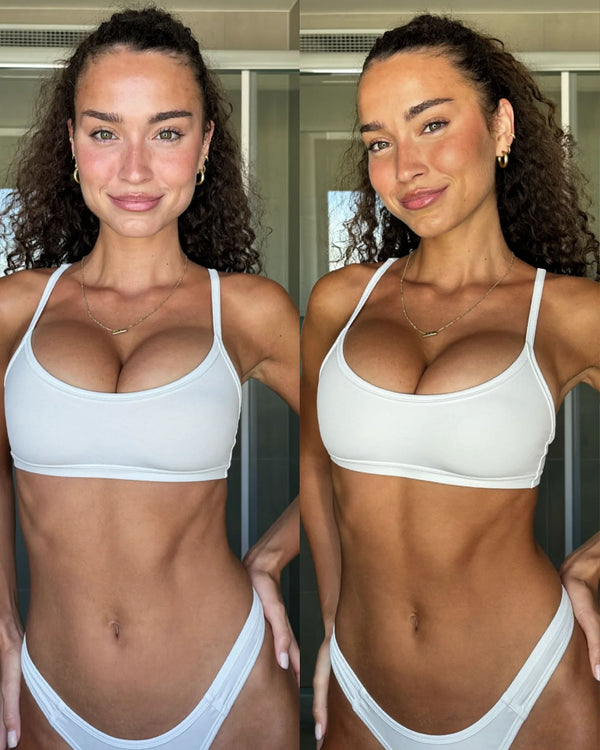




The Best Self Tanner For Fair Skin

Short answer: Fair skin looks orange with most self tanners because those formulas rely on high DHA levels that fair, red-toned skin overreacts to. A formula with a balanced, lower DHA level and an olive-toned base develops a natural bronze instead. Proper exfoliation, a good mitt, and starting with a buildable shade matter more than any single product choice.
Table of Contents
- The Struggle Most Fair Skin Self Tanners Get Wrong
- Why Fair Skin Is Different When It Comes to Self Tanning
- What About Freckles and Redness?
- The Biggest Mistake Fair-Skinned Beginners Make
- Choosing Your Shade Based on Self-Tanning Experience
- What Actually Prevents the Orange Look
- Only Clean Ingredients
- How to Get the Best Results on Fair Skin
- What Our Fair-Skinned Customers Are Saying
- Comparing Every "Best Self Tanner" List? Here's What Actually Matters
- Fair Skin Self Tanner FAQs
- You Are Not Alone in This
The Struggle Most Fair Skin Self Tanners Get Wrong
If you have fair skin, you already know the struggle. Most self tanners promise a natural glow and deliver something closer to an orange warning sign. You end up streaky, patchy, or smelling like a chemistry experiment, and the contrast between your normal skin and the tan is so jarring that you swear off self tanning altogether.
We understand this better than most brands, because one of our own co-founders is the exact person we are talking about. She is blonde, blue eyed, and naturally fair skinned. She grew up in a mountainous area where winter daylight is short, and self tanning was never really optional for her. Her mother had melanoma, so sun tanning was off the table for safety reasons long before self tanners became a real alternative, a story we go into in more depth in Is Self Tanner Safe? She has tried nearly every self tanner on the market looking for one that actually worked for her skin, which means the formulas we build at MAKAI are not guesses. They are solutions to problems she lived through herself.

Not sure where to start? Take our Find Your Glow quiz and we will match you to the shade that fits your skin tone best.
Why Fair Skin Is Different When It Comes to Self Tanning
Fair skin usually carries a red undertone, which means a self tanner formulated without that in mind can quickly slide into orange territory. We spent two years in formulation specifically addressing this, building in a subtle olive tint that balances out the red undertone most fair skin naturally has, rather than fighting against it.
Here is the science behind it, stated plainly. Most self tanners rely on high levels of DHA to force a dark result in a single application. Fair skin tends to overreact to that level of DHA, which is exactly what causes the orange cast, the uneven patches, and the faster fade that so many fair-skinned people associate with self tanning in general. It is not that fair skin cannot tan well. It is that most formulas were never built with fair skin in mind. Our formula uses a lower, balanced DHA level specifically so fair skin can develop a natural bronze tone instead of stressing into orange, and when DHA is properly balanced for your skin tone, fair skin holds color just as long as deeper skin tones, typically seven to ten days.
It also helps to know that fair skin is not one single skin tone. Someone with very fair skin and cool or red undertones can look completely different after tanning than someone with fair skin and more neutral or warm undertones. Your natural undertone matters when choosing a self tanner, because the goal is always to add warmth and dimension that works with your coloring, not fight against it.
There is also a psychological piece that most brands ignore entirely. For someone with fair skin who has never self tanned before, the contrast between their natural color and a sudden deep tan can be shocking, not because the color looks bad, but because it looks so different from what they are used to seeing in the mirror. That contrast, more than the actual shade, is what makes a lot of fair-skinned first timers panic and rinse off a perfectly good tan.
One thing we want to be upfront about: fair skin doesn't actually need a completely different product, it needs a better formula and better guidance. A lot of self tanners are built around getting you as dark as possible as fast as possible, but that's rarely what someone with fair skin is actually looking for. Most of the time, fair-skinned customers don't get bad results because of their skin. They get bad results because nobody explained how to prep properly, choose the right shade, or set realistic expectations before they applied anything. That gap in education, not a gap in product, is what we've always tried to fill.
What About Freckles and Redness?
This is one of the questions we hear constantly from fair-skinned customers, and it's personal for us too, because Toni has freckles and gets red if she spends too much time in the sun. That combination is actually one of the reasons she became so passionate about self tanning in the first place. She wanted a healthy, sun-kissed look without putting her skin through more sun exposure to get it.
Here's what she's learned over the years, and what we tell every customer who asks. Self tanner doesn't cover freckles, and it shouldn't. Your freckles are still there, they don't disappear. What changes is everything around them. Instead of freckles standing out against very pale or flushed skin, the skin around them develops a little more warmth and color, so they tend to blend in more naturally instead of standing out.
The same goes for redness. A good self tanner isn't treating redness or rosacea, that's not what it's designed to do. But by adding warmth and evening out your overall skin tone, it often makes the contrast between redder areas and the rest of your skin much less noticeable. Instead of your eye going straight to the red patches, your skin just looks more balanced overall.
Toni's advice to anyone with fair, freckled, or redness-prone skin: don't be afraid of your freckles, and don't expect self tanner to erase them. Freckles are part of what makes fair skin beautiful. The goal was never to cover them up, it's to create a healthy, even-looking complexion where your freckles still look like you, just with a little more warmth and confidence.
The one piece of advice that matters most here is not going too dark too quickly. Start with a shade that complements your natural skin tone, prep your skin well, and build color gradually if you want to go deeper. A natural-looking tan almost always looks better than forcing a dramatic change in one application.
The Biggest Mistake Fair-Skinned Beginners Make
After years of working directly with customers, the same mistake comes up again and again. People go too dark too fast.
It is rarely the formula that causes regret. It is the shock of a dramatic, immediate change. On top of that, many other brands oversaturate their formulas with DHA to force a darker result quickly, and fair skin tends to feel that more, especially without a natural base tan to soften the transition. The result is a tacky, heavy feeling on the skin that makes the whole experience unpleasant before the color even finishes developing.
Our advice is simple. Start with something buildable. Our Medium Self Tanning Mousse lets you ease into color at your own pace, and most of our Medium customers eventually move up to a Dark formula once they get comfortable seeing themselves with more color. Our own co-founder went through that exact progression, Medium, then Dark, and now she uses Ultra Dark confidently, not because the formula changed, but because her comfort with seeing herself tan did.
Below is real footage of our co-founder applying the Dark mousse to her own legs, fair skin and all, so you can see exactly how it goes on and how it develops.
Choosing Your Shade Based on Self-Tanning Experience
Fair skin does not automatically mean you have to stay with the lightest formula forever. Experience with self tanning changes what will actually look good on you, sometimes more than skin tone does. Here's how we'd break it down:
- Brand new to self tanning: Keep it simple. Start with a Medium formula and skip Dark or Ultra Dark until you understand how the product develops on your specific skin. Your first goal is learning how much product to use and how to blend it evenly, not achieving your darkest possible tan on day one.
- Some self tanning experience: Once you know how your skin reacts, you have more flexibility. You may be ready for a stronger formula or an extra layer for more depth, and your personal preference starts to matter more than a general rule.
- Experienced self tanners: You can be much more intentional with your color, including using a higher DHA formula like Ultra Dark, because you already know how to apply it and how your skin looks at different levels of color. This is exactly the progression our own co-founder went through.
What Actually Prevents the Orange Look
Most of the fear around self tanning comes down to one thing: looking fake. We built our formula specifically to avoid that on fair, cool-toned skin by balancing undertones rather than relying on a single aggressive DHA level to do all the work.
Because the color builds gradually, you are never locked into a result you cannot adjust. If you want more color, you can layer it. If you want to stay lighter, you stop where you are. Some tanners get so tacky and heavy that adding a second layer ruins the finish entirely. Ours does not work that way. You can build as much color as you want and it still looks seamless, not cakey or unnatural.
Only Clean Ingredients
Every MAKAI formula is vegan, cruelty free, paraben free, sulfate free, and gluten free. We believe a good tan should not come at the cost of what you are putting on your skin, especially if your skin is more sensitive or reactive, which is common with fair, cool-toned complexions.
How to Get the Best Results on Fair Skin
Confidence in your tan starts with proper prep, and prep matters more than most people realize. Exfoliation is just as important as the formula itself, almost as important as using a clean, high quality applicator mitt. Skipping either one is the fastest way to end up with a patchy, uneven tan, no matter how good the product is. Our How to Self Tan: The Ultimate Guide covers the full prep-to-aftercare process in more depth if you want every detail in one place.
Think of it like a little study session before a test. A few extra minutes of prep makes the entire experience easier and gives you real confidence walking into it, instead of crossing your fingers and hoping it goes well.
The entire process, prep included, takes about 14 to 20 minutes a week, which is a small trade for skin that looks naturally sun kissed all year.
- Shave the day before applying, not immediately beforehand. Shaving right before tanning can leave skin more sensitive, and giving it a day to settle creates a better surface for the formula to develop on
- Exfoliate thoroughly before applying so the formula has a clean, smooth surface to develop on evenly
- Use a clean, high quality applicator mitt to avoid streaking or staining your hands
- Apply in thin, even layers, blending well around knees, elbows, ankles, hands, and feet, where skin tends to grab more product
- Let the tan fully develop and dry before getting dressed or into bed
- Moisturize daily once your tan develops to extend how long it lasts and help it fade evenly instead of patchily

One thing we've noticed after looking at results across different climates, humid, dry, warm, cold, is that the formula itself performs consistently no matter where you live. The real difference in how a tan looks and lasts almost always comes down to aftercare, specifically, what you sleep in the first night and whether you let your skin fully dry before rinsing. Loose, breathable fabric while your tan develops, and a full dry-down before you rinse, matter more than climate ever does, and it's also exactly why self tanner doesn't have to end up on your clothes and sheets if you give it the time it needs.
Not sure which shade to start with? Browse our full shade guide to find the one that matches where you want to start.
One thing fair-skinned customers notice immediately with our formula is how it fades. Rather than the splotchy, uneven peeling you get from heavier or lower-quality formulas, MAKAI fades the way a real sun tan would, gradually and evenly, so you are never stuck with that obvious in-between phase.
What Our Fair-Skinned Customers Are Saying
We hear from customers with fair skin often, and their experiences tell the real story better than we ever could.
Emily R. from Salt Lake City, UT had spent years trying self tanners that left her looking orange or far darker than felt natural, and had basically given up on self tanning altogether. After a friend let her try MAKAI before she committed to buying her own bottle, she said it looked like she had naturally spent time in the sun and developed a soft olive glow, not like she had applied a fake tan. She specifically mentioned that it still looked like her, just healthier and more radiant, and that it was the first self tanner that did not make her feel self-conscious wearing it. She ordered her own bottle the next day.
Sydney S. shared that the product was easy to apply as a first timer, dried fast, and did not stain her white sheets. She specifically mentioned having pretty fair skin and that the result still looked completely natural on her.
Grace told us her roommate genuinely thought she had just gotten back from a beach vacation, which is exactly the kind of natural, believable color we aim for with every formula we make.
Comparing Every "Best Self Tanner" List? Here's What Actually Matters
If you've already read three or four "best self tanner" roundups before landing here, that's completely normal, and honestly, we encourage the research. The one thing we'd caution against is choosing a product just because it ranked first on somebody else's list.
Most editorial roundups are trying to find one product that works reasonably well for everyone. That's a different goal than helping you find the right self tanner for your specific skin, your routine, and the result you actually want.
If the only question you're asking is "which brand is best," that's the wrong question. A better one is: which formula fits my skin tone, my experience level, and the look I'm actually trying to achieve.
That's why so much of what we write isn't about convincing you MAKAI is the best. It's about helping you understand why one formula might fit you better than another, why prep matters as much as the product, how to choose the right shade, and what a realistic result actually looks like. If MAKAI ends up being the right fit once you understand all of that, that's great. But we'd rather you buy the right product for your skin than buy ours for the wrong reasons.
Don't compare brands until you've compared philosophies. Choose the company that's teaching you how to get a better result, not just the one telling you they're the best. That's the difference we've always tried to build with MAKAI.
Fair Skin Self Tanner FAQs
Why does self tanner turn orange on fair skin?
Most formulas use high levels of DHA to force a dark result quickly, and fair, red-toned skin overreacts to that. A lower, balanced DHA level with an olive-toned base develops a natural bronze instead.
Will self tanner cover up my freckles?
No, and it is not meant to. Your freckles stay exactly as they are, the skin around them just develops a little more warmth, so they tend to blend in more naturally instead of standing out.
Can self tanner make redness or rosacea worse?
A good self tanner is not treating redness, that is not its job, but by evening out your overall skin tone, it often makes redness less noticeable by comparison.
What shade should fair skin start with?
A buildable Medium shade is the easiest starting point. Most people move up to Dark or Ultra Dark over time as they get more comfortable seeing themselves with color.
Can I use a dark self tanner if I have fair skin?
You can, but we would not recommend starting there if you are new to self tanning. Experienced self tanners can often use darker formulas because they already understand how to apply the product evenly and how their skin responds to different DHA levels.
Does my undertone matter when choosing a self tanner?
Yes. Fair skin with cool or red undertones develops color differently than fair skin with neutral or warm undertones. The right formula should add warmth that works with your natural coloring rather than fighting against it.
How long does self tanner last on fair skin?
Typically seven to ten days when the DHA level is properly balanced for your skin tone, the same as deeper skin tones.
What is the biggest mistake fair-skinned beginners make?
Going too dark too fast. The shock of a dramatic, sudden change is usually what causes regret, not the formula itself.
How long does the whole self tanning process take?
About 14 to 20 minutes a week, prep included.
You Are Not Alone in This
If you have fair skin and have struggled to find a self tanner that actually works for you, you are not the problem. Most formulas were never built with your skin in mind.
Our co-founder has lived through every frustration fair-skinned tanners face, the orange tint, the tacky feel, the patchy fade, the fear of going too dark too fast. That experience shaped every formula we make. Whether you start with our Medium mousse to ease into color or a gradual lotion for a soft, everyday glow, the goal is the same. A natural, believable tan that builds at your pace and fades the way real sun-kissed skin should. Don't just take our word for it either, we broke down what 550 real MAKAI customers actually said about their results.
This same philosophy applies no matter your age. If mature skin is more of what you're working with, our guide on the best self tanner for mature skin covers the exact same idea, your skin is still skin, and it deserves a formula built around how it actually behaves, not a marketing label.
Still not sure where to begin? Take the Find Your Glow quiz, or start with the shade most fair-skinned customers reach for first: our Medium Self Tanning Mousse.


